
Have you ever wondered why such a small part of your wrist can have such a big impact on your hand?

The answer lies inside a narrow passageway called the carpal tunnel. Although it is only a small space, it contains important structures that allow your fingers and thumb to move smoothly every day.
Before learning how Carpal Tunnel Syndrome develops, it’s helpful to first understand what is inside this remarkable tunnel.
What Is the Carpal Tunnel?
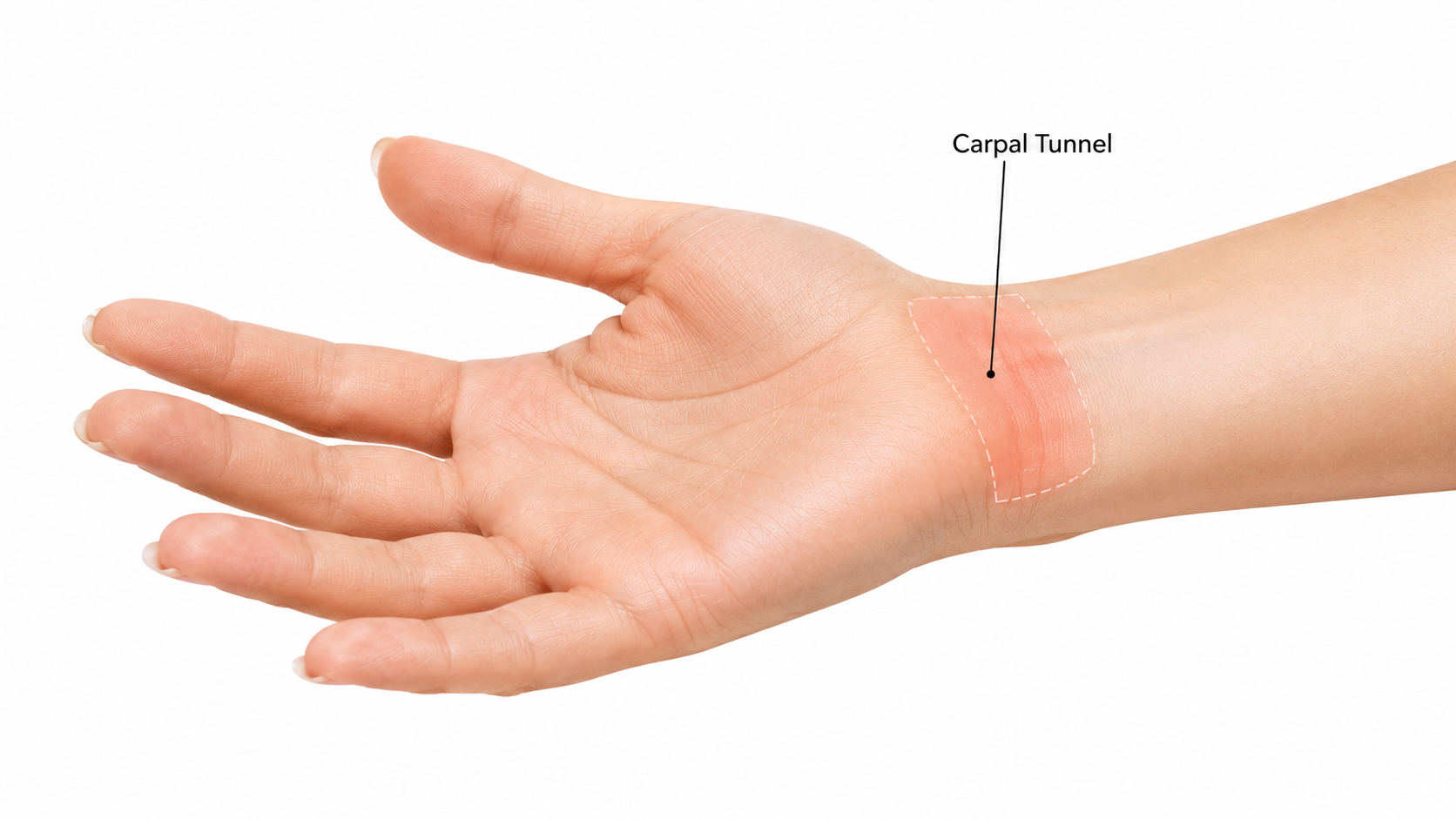
The carpal tunnel is a narrow passageway located on the palm side of the wrist.
Think of it as a small tunnel that safely guides important nerves and tendons from your forearm into your hand.
Because this space is naturally very narrow, everything inside it must fit together precisely.
The Roof of the Tunnel
The roof of the carpal tunnel is formed by a thick band of connective tissue called the transverse carpal ligament.
This strong ligament acts like a protective roof, keeping the tendons and the median nerve securely in place as your hand moves.
Unlike muscles, ligaments have very limited ability to stretch.
The Floor of the Tunnel
The floor and sides of the tunnel are formed by eight small wrist bones, known as the carpal bones.
Together, these bones create a stable arch that supports the structures passing through the wrist.
Since bones are rigid, the size of the tunnel changes very little.
What Travels Through the Tunnel?
Median Nerve
The median nerve carries sensation from the thumb, index finger, middle finger, and part of the ring finger.
It also controls several muscles that help move the thumb, making everyday tasks like buttoning a shirt or holding a cup possible.
Flexor Tendons
Running alongside the median nerve are nine flexor tendons.
These tendons connect the muscles of the forearm to your fingers and thumb.
Every time you type, write, grip a steering wheel, or pick up your phone, these tendons glide smoothly through the carpal tunnel.
Why Understanding Anatomy Matters
The carpal tunnel is a carefully organized space where bones, ligaments, tendons, and nerves work together in perfect coordination.
Understanding this normal anatomy makes it much easier to understand why Carpal Tunnel Syndrome develops. Next, read What Is Carpal Tunnel Syndrome? Understanding the Symptoms and How Massage May Help.
Clinical Perspective
In my clinical experience as a licensed massage therapist, many clients are surprised to learn that finger movement actually begins with muscles in the forearm rather than the hand itself.
Learning the basic anatomy often helps people better understand how their hands function during everyday activities.
Educational Note
This article is intended for educational purposes only and should not be considered medical advice. If you are experiencing persistent numbness, weakness, or pain in your hand or wrist, consult a qualified healthcare professional.